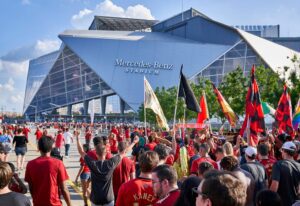
Big events bring visibility, but if the streets and squares around a stadium aren’t as functional the next morning, cities lose the opportunity for long-term return. HGOR works upstream, planning to shape public experience and drive long-term value. Our work in some of Atlanta’s most historied districts shows what happens when design decisions account for both surge and stillness.
The Overlooked Edge: What Most Cities Miss
Cities pour energy into the stadium, but the places that support it—the blocks, corners, corridors and public spaces in the surrounding areas—often receive far less attention. Yet it is in these very places that long-term value is won or lost. When the surrounding fabric lacks activation, clarity, comfort, or purpose, cities face real costs:
- Decreased activity and post-event dwell time
- Safety and circulation challenges
- Frustrated visitors, disappointed vendors, and annoyed residents
- Missed opportunities for economic return and civic identity
HGOR’s value: We look beyond the venue to design the city that supports it. We plan the edges where real urban performance happens. Our work addresses how entertainment destinations connect to their neighborhoods—how people arrive, move, and linger—and how public spaces and local businesses thrive long after the event ends. By shaping the places both in and around major destinations, we’re helping cities build enduring value, not just event-day excitement.
Atlanta’s South Downtown: A Hub Designed to Support
South Downtown—Atlanta’s historic core just south of Five Points—is reemerging as a key cultural and civic connector. Flanked by Centennial Yards, Mercedes-Benz Stadium, and MARTA’s central spine, it’s a complex, evolving, historical urban district.
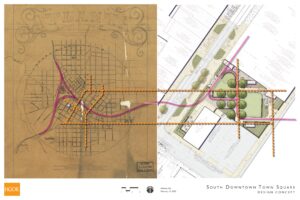
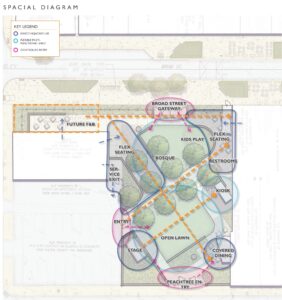
A public space at the heart of the transformation anchors the 57 building renovations that span just 16 acres. More than a centerpiece for event surges, it is the heartbeat of a renewed urban community that’s bringing daily life back to the city’s core. HGOR’s design allows the space to serve as both a civic stage and a neighborhood living room: a place for workday lunches, children to play, or friends to grab a drink after hours. On Atlanta United match days, it becomes a rallying ground for thousands of “Five-Stripers” ready to launch with the city’s collective pride. Rooted in the district’s history at the convergence of rail lines and street grids, the plaza’s geometry and materials reinterpret that legacy into a contemporary civic landmark ready to support local entrepreneurs and businesses—such as El Tesoro and Broad Street BBQ. Both a social amenity and an economic catalyst, this work is helping reestablish South Downtown as a place where Atlantans can connect, create opportunity, and once again put down roots in the heart of their city.
What set this work apart was the design mindset. “You plan for the surge,” said Chris Mutter, Principal in Charge of the project for HGOR. “But it must work when there’s nothing happening in the city. That’s the real test.”
In collaboration with district partners, HGOR worked to embed flexibility such as walkable connections, integrated shade and comfort, and vendor zones that function across both event days and quiet mornings.
The result is a civic space that performs year-round, delivered by planning with civic ROI in mind and a clear vision for how the communities surrounding Atlanta’s sports and entertainment venues can evolve beyond the event.
Unlocking Opportunity After the Final Inning: Turner Field Redevelopment
When the Atlanta Braves left Turner Field in 2017, the site was at risk of becoming another stranded asset.
When the announcement was made in 2014, HGOR saw an opportunity to reconnect the area with the city and partnered with Carter USA to guide the early planning of what would revitalize the soon-to-be abandoned district. Through a comprehensive study of the site’s many influences, we created an early framework that helped the owners understand the possibilities of redeveloping the Turner Field area into a walkable, mixed-use district that is today’s thriving Summerhill neighborhood.
HGOR identified opportunities to connect the site to the city through transit-oriented development, outlined spatial definition and potential land uses, and established a framework for the thoughtful re-organization of blocks, circulation patterns, and public open spaces.
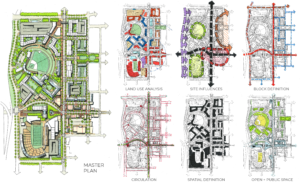
“We helped shape the public realm before anyone had the site plan figured out. We weren’t drawing sites and buildings. We were opening doors.” – Chris Mutter
Turner Field’s redevelopment was a pivot point, not just for the site but for Atlanta’s next era of civic investment. Our same early-planning approach now informs projects like The Stitch, where public realm design is once again being asked to do more: connect, anchor, and endure.
In just 10 years post-master plan, Summerhill witnessed a remarkable turnaround, including:
- 1,200+ new townhomes and apartments
- new 120-key hotel with 9,000 SF of retail
- 20 new businesses across 35,000+ SF of retail space
- former Turner Field parking lots infilled with office space
- Summerhill Station (which was strategically positioned along Hank Aaron Drive) has become a thriving hub with a 50,000 SF Publix and two Piedmont Healthcare facilities.
Centennial Yards: Reconnecting the Grid, Reclaiming the Core
Centennial Yards is more than a redevelopment. It’s a once-in-a-generation opportunity to heal what downtown Atlanta lost decades ago. By reconnecting the street grid and repairing long-disconnected blocks, the project is restoring walkability, access, and long-term value across a massive footprint between key venues and neighborhoods.
In this context, public realm design is about enabling a district to work operationally and economically, whether it is on a match day, a workday, or years after opening day. The sidewalks, plazas, and green spaces need to carry the weight of civic life, looking beyond site lines to focus on what drives engagement and performance.
Projects like Centennial Yards are examples of planning for the greater good. It is encouraging to see development done well and to see long-neglected sites grow, flourish and enhance historied cities like Atlanta. This thoughtfully delivered multifunctional space will provide a strong ROI for citizens and the city alike.
Planning for What Comes Next
Whether it’s in South Downtown, Summerhill, or on the state of Georgia’s most urban campus, HGOR is actively working upstream to set the public realm up for long-term success post-World Cup. Embedding our SEE Philosophy into every plan means thinking about how spaces invite people in, how they support neighborhood vitality, and how they hold up to time, use, and climate.
We build frameworks that let people, places, and investments thrive long after the event ends. Let’s talk about how your district performs after the final whistle.
Just one click to start the conversation: cmutter@hgor.com