
By Todd Fuller, Principal | HGOR
Hear me out, but I think people who don’t call me before the interview are a little crazy.
There are a couple reasons why. I love early collaboration and I love helping teams win work at the interview. There’s an energy to the pursuit process that brings out some of the best thinking from a design team.
More importantly, I know that when collaboration and participation happen prior to an interview, it moves the needle toward a win. The client gets engaged. The team demonstrates successful collaboration. Opportunities are unlocked.
To me, that’s what a great interview is about—not showing up with all the answers but starting the right conversation. It shouldn’t just show a client what you’ve done before. It should show them what you could do together.

The Interview Is More Than a Presentation
Too often, interviews become presentations of completed work. While experience certainly matters, clients are also evaluating something less tangible: how a team thinks and works together.
The interview is an opportunity to demonstrate collaboration and curiosity, not certainty. Rather than arriving with predetermined design solutions, HGOR approaches pursuits by asking thoughtful questions, listening carefully, and engaging clients in conversation. When an interview becomes a dialogue instead of a presentation, everyone benefits.
That perspective often surprises clients. We’ve heard owners say, “We weren’t expecting the landscape architect to be part of the interview.” And when we hear that in an interview, we know we gave the team an advantage.
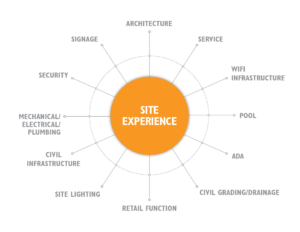 For us, that’s an opportunity. It demonstrates that the entire design team is thinking holistically—not just about the building, but about how the project functions within its larger context. Everyone in the interview room is focused on something different. Whether it’s operations, branding, facilities, sustainability or budget, site strategy gives us a way to connect those priorities into a single conversation. It’s about disarming and engaging, without being prescriptive.
As planners and landscape architects, we naturally create those conversations by sitting at the intersection of so many disciplines. We think about building placement, circulation, open space, stormwater, infrastructure, user experience, and long-term growth simultaneously. Our goal is to bridge architecture, engineering, and economics with the human experience of a place.
We Lead with Questions, Not Answers.
The interview is not a time to lead with ego or preconceived solutions. It’s a time to understand what success looks like for the client and begin exploring possibilities together for the first time.
That starts with listening.
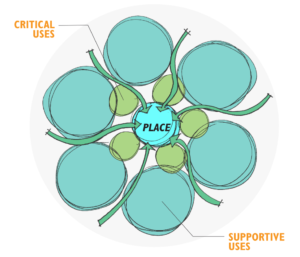
Rather than saying, “Here’s the solution,” we ask, “Have you thought about this?”
- Could the building be oriented differently to strengthen campus connections?
- Could an open space replace infrastructure to create a more memorable gathering place?
- Could stormwater become an amenity rather than a hidden utility?
- Could today’s decisions create flexibility for tomorrow’s expansion?
Those questions don’t prescribe a design. They simply open the door to opportunities that may not have been considered.
The goal isn’t simply completing another project. It’s helping clients create places that are greater than the sum of their parts.
Finding Opportunity Where Others See Constraint
Creativity isn’t about presenting the biggest idea in the room. It’s about finding practical solutions that improve the project while respecting the client’s investment.
Our planning background allows us to think at two scales simultaneously. Every project has immediate needs, but every project also exists within a larger story. Whether we’re working on a university campus, healthcare district, mixed-use development, or civic project, we are always asking how today’s investment contributes to something greater over time.
When a site is planned thoughtfully, it often has one of the greatest influences on how people perceive an entire project. We’re looking at circulation patterns, building placement, event spaces, pedestrian connections, future phases, existing trees, grading, parking, and stormwater—not as separate problems to solve, but as interconnected opportunities.
The best ideas aren’t the most expensive. More often, they’re the result of understanding how a site can work harder for the owner, the users, and the community.
Better Pursuits Lead to Better Partnerships
At HGOR, we don’t come into pursuits trying to make our logo bigger than someone else’s. We aren’t interested in proving our ideas are better. We simply want to be a great teammate. Our relationships and ability to deliver are our currency.
That means listening first, thinking strategically, connecting disciplines, and helping uncover opportunities that create lasting value for the owner and the people who will ultimately experience the place.
The interview is the first opportunity. It’s the moment when teams can ask questions, uncover opportunities, and begin building trust—not only with one another, but with the client.
The best projects don’t begin with the perfect design. They begin with the right questions to frame a conversation, and the right team around the table. Let’s talk.
Reach out to Todd Fuller via email at tfuller@hgor.com or by phone at (404) 929-3394.