Doraville, Georgia
Client: The Gipson Company
Size: 135 acres
Status: Completed 2023
Awards:
2025 Best in Real Estate: Industrial Properties & E-Commerce
Atlanta Business Chronicle
Collaborators: Smith Dalia Architects, Bailey Construction
Reimagining legacy through resilient, purpose-built design.
HGOR led the planning and public realm design for Assembly Atlanta, a transformative redevelopment of the former General Motors assembly plant in Doraville. Working in collaboration with The Gipson Company and Gray Television, one of the nation’s largest broadcasters, the project converts the historic industrial site into Georgia’s largest purpose-built production campus and establishes a new model for integrating concept-driven placemaking with sustainability, resiliency, and functional planning that uplifts community and celebrates Georgia’s creative identity.
HGOR approached the site through multiple lenses—blending secure, high-functioning studio operations with a vibrant, accessible public realm. Streetscapes, parks, and facades were crafted to serve dual purposes: cinematic backdrops and community amenities. A robust stormwater system, including a 2.75-acre studio pond and a 4-acre public park, manages runoff while enhancing ecological health and providing filmable, programmable landscapes. Locally sourced materials reflect a commitment to Georgia’s economy and environmental stewardship. Through interdisciplinary collaboration, HGOR led the planning to deliver a resilient framework that supports simultaneous productions, future expansion, and a rich public experience.
Reclaiming a Historic Industrial Site
For nearly 70 years, the Doraville property was dominated by automobile production buildings and expansive paved surfaces. The Assembly Atlanta redevelopment transforms this abandoned, historic industrial landscape into a dynamic mixed-use district centered on filmable environments, cutting-edge production facilities, and public spaces. HGOR’s planning framework reintroduces walkable streets, open space, and ecological systems across a brownfield site once defined by heavy manufacturing.
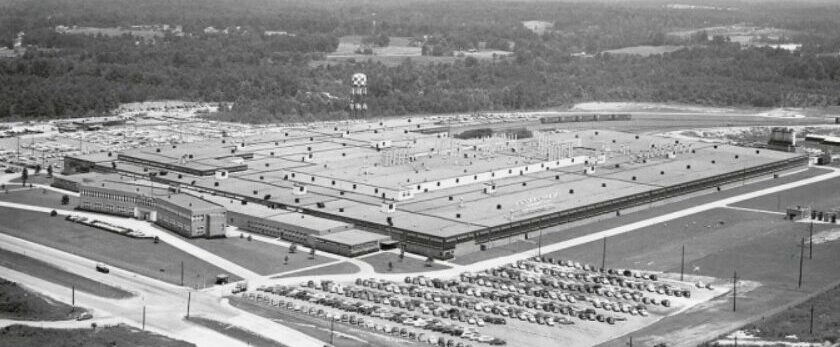
Former General Motors Assembly Plant
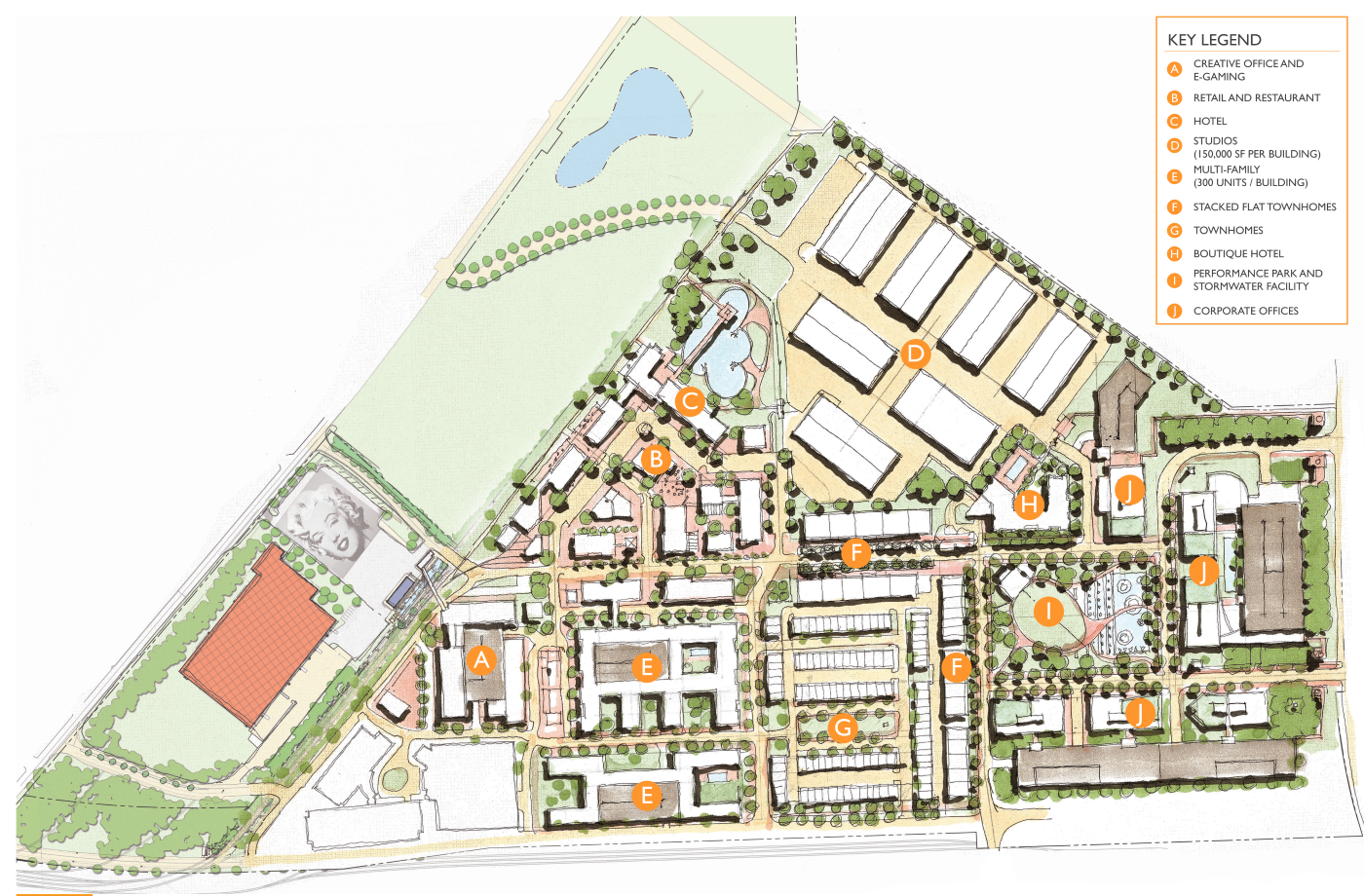
Later dubbed the “Idea of the Idea,” HGOR worked with the client to develop the conceptual plan pictured above, which informed the organization of the overall site and launched the first phase of development.
Organizing Georgia’s Largest Studio Campus
Blending the needs of a secure, high-functioning film studio with the aspirations of a vibrant mixed-use public environment required careful coordination. Phase I of the development, Assembly Studios, delivers 21 buildings totaling approximately 1,000,000 square feet of stage, office, mill, warehouse, and administrative space to support multiple productions simultaneously. HGOR worked closely with civil engineers to integrate complex infrastructure and utility systems while coordinating base camps, pedestrian movement, vehicular circulation, and adjacency requirements.
Beyond the studio walls, surrounding public streets were planned within a flexible street grid. Blocks can be individually closed for filming while maintaining circulation throughout Assembly Atlanta and its public spaces.
The Public Realm & Stormwater Park
While much of the site functions as a controlled studio campus, HGOR’s design also prioritizes environmental performance and public access. When the GM plant occupied the property, no stormwater infrastructure existed for the 75-acre building footprint or adjacent paved areas. The redevelopment introduces a comprehensive stormwater system that manages runoff, improves water quality within the Nancy Creek and Peachtree Creek watersheds, and anticipates future development across the site.
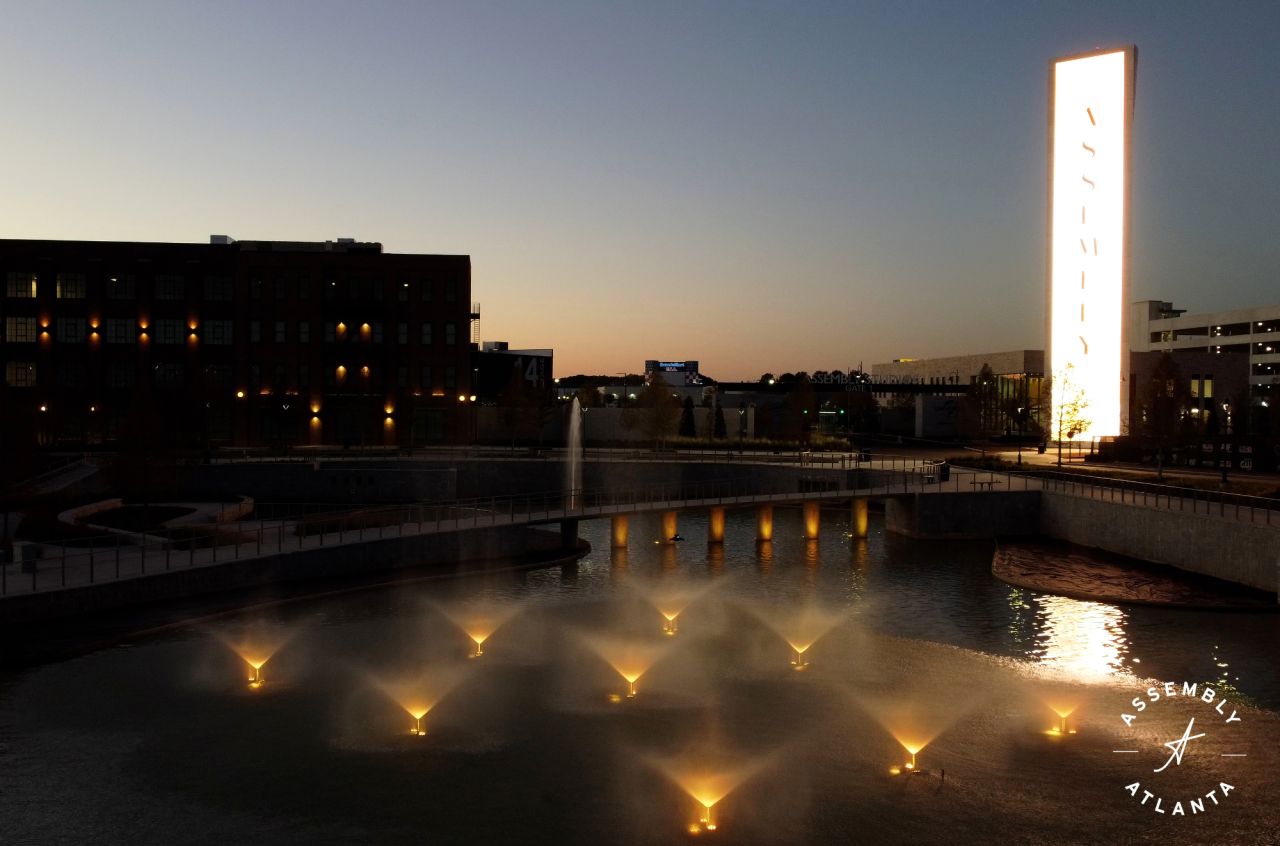
A 2.75-acre studio pond anchors the studio campus, serving as both stormwater detention and a multifunctional amenity that supports filming, events, and visual identity.
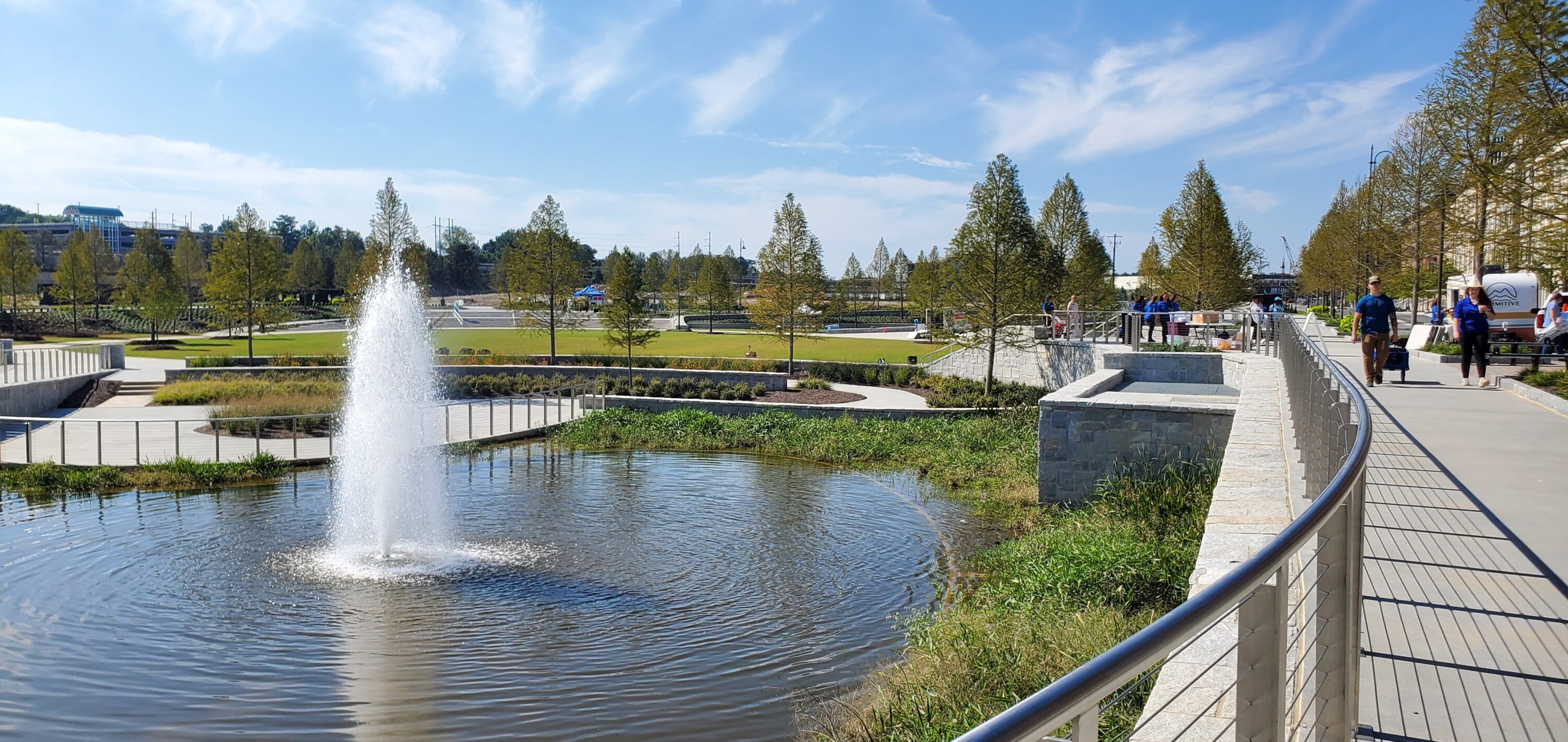
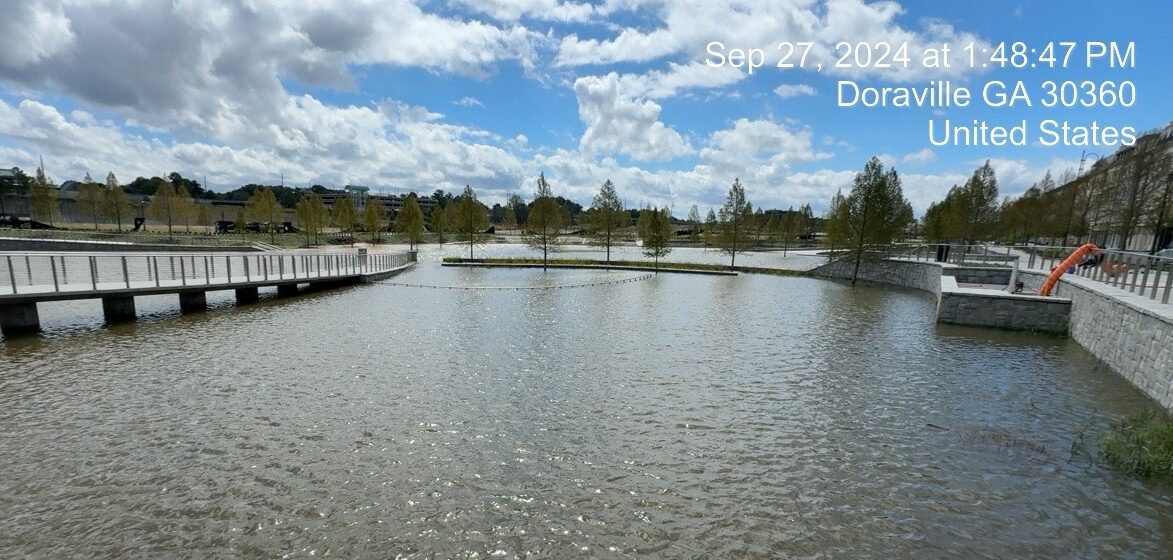
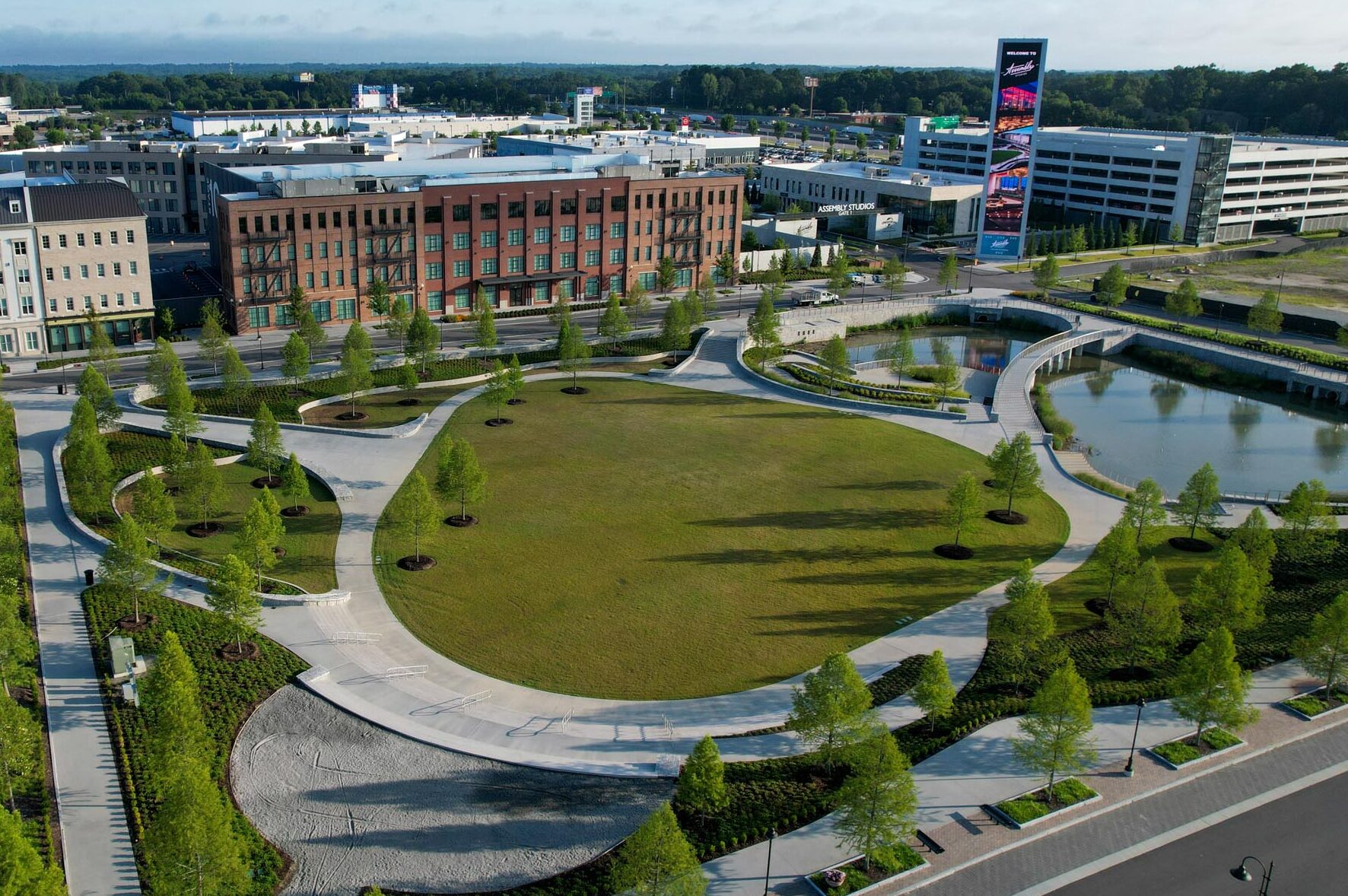
The 4-acre public park was designed with a similarly dual-purpose approach. In addition to providing accessible greenspace, the park manages stormwater from surrounding development and is capable of handling runoff from more than 50 acres of the site, with a holding capacity exceeding three million gallons.
Pictured top: 4-acre public park & stormwater pond on October 5, 2024
Pictured bottom: Park & stormwater pond just one week prior, holding stormwater
detention during Hurricane Helene’s 100-year storm event in Atlanta.
Designing a Park for Events and Experience
While functioning as a detention basin, the public park integrates a one-acre lawn within an experientially rich landscape of meandering paths, gardens, overlooks, and recreational spaces. Designed to accommodate events both large and small, the park can host up to 5,000 people for performances and gatherings centered around a covered stage venue.
On the opposite corner of the park, an iconic 140-foot-tall LED tower provides a dramatic visual backdrop. One of the largest freestanding LED towers in North America, the structure required complex design coordination and now offers 22 feet by 136 feet of screen space for event displays, film promotions, and revenue-generating advertisements.
A Long-Term Investment in Atlanta’s Creative Economy
Assembly Atlanta represents the first phase of a long-term redevelopment that will reshape the Doraville site into a major hub for film, media, and mixed-use development. By transforming a historic brownfield site into a creative production campus, the project strengthens Georgia’s leadership in film and television production while delivering lasting economic and cultural benefits for the region.